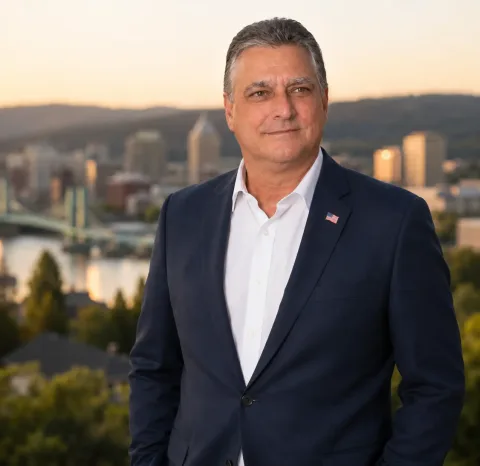
One favors targeted federal investment and healthcare protections. The other proposes a much smaller federal role in several policy areas and stricter immigration enforcement.
Draft; human review pending.
Key
Said
A campaign statement, in our summary or their words.
Voted
A recorded Council roll call.
— Not found
Not in the sources we reviewed. A research gap, not a position.
Advocates stronger state and local control, fewer federal subsidies and regulations, domestic manufacturing and stricter immigration enforcement.
Growth to cut homelessness; opposes federal funds for NGOs he says keep people dependent.
Would secure the border, remove unauthorized entrants, make aiding illegal crossings a felony.
Would end corporate subsidies and noncitizen loan programs, strip conditions from federal grants.
Would transfer federal public lands to state and local control; affordable energy decided locally.
Summaries are our one-line readings of what each candidate says. Issue lines are short forms of the positions in each brief, AI-drafted and awaiting human review; “—” means not found in the sources we reviewed.
Four votes that split this Council
No candidate in this race sits on Council today.
— Not foundNo featured votes are selected for this race yet.
Candidate briefs, A–Z
U.S. House · District 6 candidate · U.S. Congress · November 3, 2026
Andrea Salinas
Incumbent U.S. representative; former state legislator.
Said: As the daughter of a Mexican immigrant whose father worked in the fields before serving in the military, Andrea knows that change can happen in a generation through hard work.
Voters’ pamphlet
Candidate statement · Filed for the November 2026 pamphlet; posted by the Secretary of State September 9, 2026; extracted September 21, 2026
Verbatim opening of the candidate's own statement; publication by the state does not verify the claims. Nothing was skipped before it.
The verbatim opening of their voters’ pamphlet statement, the same rule for every candidate. We chose nothing.
What they say they would do
Our summary of their platform, in our words
Supports lower prescription costs, broader mental-health access, housing investment and federal protection of abortion access.
Expand Medicare drug-price negotiation and mental-health services.
Increase housing supply and assistance.
Combine border security with more efficient immigration courts and protections for established immigrant communities.
Our reading
Our interpretation, not their words
Targeted federal investment
Health-care access
Federal housing money, mental-health bills and drug-price caps are incremental and bipartisan by design; the reviewed pages show bills and grants, not which would come first under a tight budget.
Said: Would invest in affordable housing and emergency shelters, support legislation for two million affordable homes over a decade, and prioritize housing for unhoused people and unaccompanied homeless youth.
How
Said: Federal funding for affordable-housing projects (she cites Tigard and Newberg) and the Housing for the 21st Century Act, plus additional emergency-shelter funding for Oregon.
Measured by
Said: Two million affordable homes built nationally in the next decade under the legislation she supports.
Public safety and immigration
Fund police and services
What
Said: Would fund first responders and social services, keep working with police on fentanyl including stiffer trafficker penalties, invest in smart border security, streamline immigration courts and protect communities from what she calls ICE's violent overreach.
How
Said: Federal grants for community service officers and rural fentanyl enforcement, a bill on firefighter mental health, and Border Security Task Force work pushing smart border investment and faster immigration courts.
Measured by
— Not in their sources
Taxes, spending and your bills
Cap drug prices
What
Said: Would cap prescription drug costs and let Medicare negotiate prices, seek middle-class tax relief instead of billionaire tax breaks, and bring living-wage jobs to Oregon.
How
Said: Medicare drug-price negotiation and hospital and insurer price transparency; three free behavioral-health visits a year for Medicare and Medicaid recipients under her HOPE and Mental Wellbeing Act.
Measured by
— Not in their sources
Transportation, energy and climate
100% green energy
What
Said: Would put Oregon on a path to 100% green energy, stand up to corporate polluters, and protect air and waterways; prioritizes public infrastructure over corporate-owned data centers.
How
— Not in their sources
Measured by
Said: 100% green energy for Oregon; no date is given.
The choices this office faces
Every candidate in this race is asked the same 8 questions. Andrea Salinas is on record on 8. A question without an answer is a research gap, not a position.
On record
Keep H.R. 1’s Medicaid work rules, six-month renewals and SNAP cuts, or repeal them?
Said: Voted no on final House passage of H.R. 1 on July 3, 2025 (218–214), a vote on the whole package, including the Medicaid work rules, six-month renewals and SNAP cuts.
Restore the enhanced Affordable Care Act premium tax credits that expired December 31, 2025?
Said: Voted yes on January 8, 2026 on H.R. 1834, a three-year restoration of the enhanced premium tax credits; it passed 230–196 and awaits the Senate.
End the tariffs and take tariff power back from the president?
Said: Voted yes on February 11, 2026 on H.J.Res. 72 to end the national emergency behind the Canada tariffs; it passed 219–211.
Fund the $70 billion expansion of ICE and Border Patrol through 2029 (the Secure America Act)?
Said: Voted no on June 9, 2026 on the Secure America Act’s $70 billion for ICE and Border Patrol through 2029; it passed 214–212.
Direct the president to end U.S. military involvement in the war with Iran?
Said: Voted yes on July 23, 2026 on H.Con.Res. 89 directing the president to remove U.S. forces from hostilities with Iran (214–208), as on June 3.
Pass the Fix Our Forests Act: faster thinning and logging on federal forests with shorter windows to sue?
Said: Voted no on January 23, 2025 on the Fix Our Forests Act (H.R. 471), which passed 279–141.
Expand the federal role in housing, from the new ROAD to Housing law to more vouchers and tax credits?
Said: Voted yes on June 23, 2026 on final passage of the 21st Century ROAD to Housing Act (358–32), now Public Law 119-101.
Should federal policy rein in data centers’ power, water and cost impacts, or keep fast-tracking them?
Said: Says she prioritized public infrastructure over corporate-owned data centers; her statement does not say what federal rule or funding choice that involved.
Voted No on the final House motion accepting the Senate’s H.R. 1 amendment, July 3, 2025. It passed 218–214. This records a vote on the entire package, not a separate vote on each provision.
Oregon voters’ pamphlet candidate statement · PDF page 27Candidate statement · Filed for the November 2026 pamphlet; posted by the Secretary of State September 9, 2026; reviewed September 21, 2026Campaign position. Claimed results and numerical premises have not automatically been independently verified.
U.S. House · District 6 candidate · U.S. Congress · November 3, 2026
David Russ
Former Dundee mayor.
Photo: Campaign photo · russisforus.com
In their words
Said: Oregon deserves representation that works for the people, not the system. Our government has continuously grown more powerful while families, businesses, and rural communities have been pushed aside.
Voters’ pamphlet
Candidate statement · Filed for the November 2026 pamphlet; posted by the Secretary of State September 9, 2026; extracted September 21, 2026
Verbatim opening of the candidate's own statement; publication by the state does not verify the claims. Nothing was skipped before it. The first sentence is under 12 words, so the first two are shown.
The verbatim opening of their voters’ pamphlet statement, the same rule for every candidate. We chose nothing.
What they say they would do
Our summary of their platform, in our words
Advocates stronger state and local control, fewer federal subsidies and regulations, domestic manufacturing and stricter immigration enforcement.
Transfer federal public lands toward state or local control.
Reduce federal control over schools, utilities, business and infrastructure.
End subsidies to large corporations and federal subsidies or loans to noncitizens.
Our reading
Our interpretation, not their words
Local control
Smaller federal role
Returning lands, schools and utilities to state control and ending conditional federal grants would shift both authority and hundreds of billions of dollars; who funds those responsibilities afterward is not addressed in the reviewed pages.
Said: Says nearly all his proposals would reduce homelessness by strengthening the economy, and opposes federal money for NGOs, which he says spend more on staff, consulting and programs that keep homeless people dependent than on helping them become independent.
How
— Not in their sources
Measured by
— Not in their sources
Public safety and immigration
Secure border, removals
What
Said: Would secure the border and remove people who entered illegally, make aiding illegal border crossers a federal felony, and require U.S. attorneys to take roughly 98% of referred cases to trial.
How
Said: A Prosecutorial Requirements bill making U.S. attorneys try about 98% of cases referred by law enforcement or lose their jobs; a federal felony for aiding or abetting illegal border crossers.
Measured by
Said: Says the measure is a stronger economy and higher wages for citizens, which he attributes to fewer people in the country illegally.
Taxes, spending and your bills
End corporate subsidies
What
Said: Would end subsidies that benefit only large corporations and federal subsidy or loan programs for noncitizens, strip conditions from federal grants to states through a No Strings Act, and end what he calls the IRS manhunt of 1099 employers.
How
Said: A No Strings Act voiding conditions on federal grants beyond a project’s scope and blocking federal funds to non-government agencies without audited contracts.
Measured by
Said: Says the act would save hundreds of billions a year, possibly over $1 trillion, returned to local economies; no independent estimate is cited.
Transportation, energy and climate
Local control of lands
What
Said: Would return federal public lands to state and local control, end federal control of local utilities and infrastructure, and support responsible forest and agricultural management, reliable infrastructure and affordable energy decided locally.
How
Said: Says he has no specific process yet; returning federal lands other than national parks to the states would, he says, also reduce the federal budget.
Measured by
— Not in their sources
The choices this office faces
Every candidate in this race is asked the same 8 questions. David Russ is on record on 8. A question without an answer is a research gap, not a position.
On record
Keep H.R. 1’s Medicaid work rules, six-month renewals and SNAP cuts, or repeal them?
Said: Would keep H.R. 1’s Medicaid and SNAP rules as long as the federal government is involved.
Restore the enhanced Affordable Care Act premium tax credits that expired December 31, 2025?
Said: Says the Affordable Care Act has damaged affordability and is federal overreach; would support another option while it is unwound rather than restoring the credits.
End the tariffs and take tariff power back from the president?
Said: Does not support ending the tariffs, noting the country funded itself largely through tariffs before the 1913 income tax.
Fund the $70 billion expansion of ICE and Border Patrol through 2029 (the Secure America Act)?
Said: Fully supports giving federal law enforcement enough money to do its job efficiently; says the border is now secured.
Direct the president to end U.S. military involvement in the war with Iran?
Said: Says only people in the highest-level national-security meetings can make this call and he has not been in one; he does not say whether to end U.S. involvement.
On the topic; the exact choice is unsaid.
Pass the Fix Our Forests Act: faster thinning and logging on federal forests with shorter windows to sue?
Said: Calls the Fix Our Forests Act “OK” but a bureaucratic maze; would support it only as a stopgap, saying the states could run the same program for less after federal lands are returned.
Expand the federal role in housing, from the new ROAD to Housing law to more vouchers and tax credits?
Said: Says current federal involvement in housing already violates the 10th Amendment; states that want such programs should run them.
Should federal policy rein in data centers’ power, water and cost impacts, or keep fast-tracking them?
Said: Opposes federal involvement, saying lobbying would tilt deals toward data centers; local officials should negotiate terms, as he says some cities have done to secure benefits such as free power.
Said: Nearly every one of my statements, proposed Bills, and proposed actions will lead to reduced homelessness. My goal is to return the country, and prosperity, to the people. When the economy soars, homelessness will drop dramatically. Giving money to NGO’s to over pay their bloated staff only exacerbates the problem. We can not continue with the failed policies created by Progressive theology.
Received 2026-09-24
Housing and homelessness (his clarification)
Said: My statement regarding distribution of federal funds was regarding NGO’s. I did not say “non-profits.” Many NGO’s are non-profit, but not all. [...] These entities spend more on their staff, consulting, and programs that actually make the homeless dependent on them than what they spend helping the homeless to become independent.
Received 2026-09-25
Transportation, energy and climate
Said: I have not created a specific process by which I intend to make this happen, however, since the US Constitution does not provide for the Federal Government controlling large swaths of lands within state boundaries this should really not be a complicated issue. Removing lands that are not specifically National Parks Open to all, will also reduce the Federal Budget.
Received 2026-09-24
ICE and border money
Said: I fully support ensuring that Federal Law Enforcement has sufficient funding to efficiently perform their duties.
Received 2026-09-24
Fix Our Forests Act
Said: The Fix Our Forests act is OK. However, it is basically a bureaucratic maze designed to give the bureaucrats a way to claim they are doing things right while simultaneously wasting huge amounts of money in consulting and administration. I would support this legislation only as a gap stop. However, the fact is States could administrate exact same program for less.
Received 2026-09-24
Medicaid and SNAP cuts
Said: Yes. Keep rules as long as the Federal Government is involved.
Received 2026-09-24
ACA premium credits
Said: The “Affordable Care Act” has clearly damaged healthcare affordability. The issue is complicated, and Federal Overreach. I would support another possibility while it is unwound.
Received 2026-09-24
Tariffs
Said: I do not support such a thing. That would require a re-write of The Constitution. This nation had no income tax and funded virtually everything via Tariffs until 1913 (137 years!).
Received 2026-09-24
Iran war powers
Said: Anyone who has not participated in the highest level of National Security meetings in the White House only “imagines” that they have sufficient information to make a call on this issue. I have not been in one of those meetings.
Received 2026-09-24
Federal housing programs
Said: The current level of Federal Involvement in housing is already a huge violation of the 10th Amendment. [...] If States believe that this type of program is important, they should institute them internally.
Received 2026-09-24
Data-center costs
Said: At this point, smart municipalities are cutting deals with data centers that are very favorable for the municipality. Some have even secured free power for their residents! If the Federal Government gets involved it will undoubtedly start to skew the deals toward the data centers due to federal lobbying. [...] Smart people in local areas need to cut the right deals for their constituents.
Received 2026-09-24
A question the evidence leaves open
Which transfers and spending reductions would you pursue first, and who would fund the responsibilities shifted to states or localities?
Oregon voters’ pamphlet candidate statement · PDF page 29Candidate statement · Filed for the November 2026 pamphlet; posted by the Secretary of State September 9, 2026; reviewed September 21, 2026Campaign position. Claimed results and numerical premises have not automatically been independently verified.
Russ · campaign platform (home page)Candidate statement · Website reviewed September 21, 2026Campaign position. Claimed results and numerical premises have not automatically been independently verified.
Russ · proposed billsCandidate statement · Website reviewed September 21, 2026Campaign position. Claimed results and numerical premises have not automatically been independently verified.
Russ · correction and clarification emailed to the LabCandidate statement · Received September 25, 2026Written by the candidate in reply to the Lab and kept on file; his words are quoted on his brief. Receipt does not verify the claims.